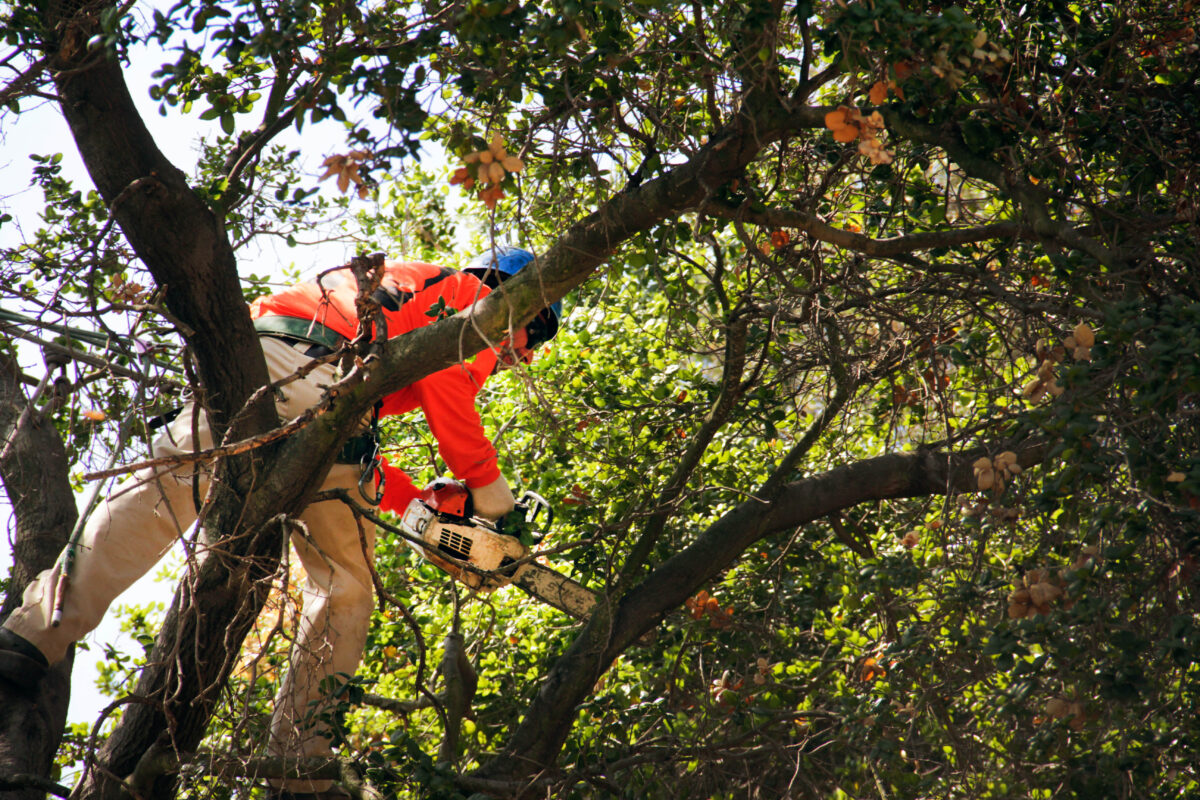
The best time for tree trimming or to prune your trees is during the dormant period, usually in late winter from November to March.
During the dormant period is the best time for tree trimming; usually in late winter from November to March. Dead or diseased branches should be removed as soon as possible. Pruning done during the dormant season tends to have an invigorating effect on tree growth. Pruning done during peak growth times tends to slow growth by removing leaves that manufacture nourishment. However, too much summer pruning can damage a tree. Pruning during the spring (post-dormancy) and fall (pre-dormancy) is generally the least desirable time as the plant is most vulnerable during those times.
Berries and tree fruits are pruned November until bloom; prune blooming ornamentals during and immediately after bloom.
When you cut away part of a plant, a wound is left, susceptible to pests and diseases. To avoid trouble, always prune so as to make small wounds, rather than large ones. Removing a bud or twig produces a smaller wound than waiting until it is a large limb! Rubbing off a sucker bud leaves a smaller wound than if you wait until it has a year’s growth or more.
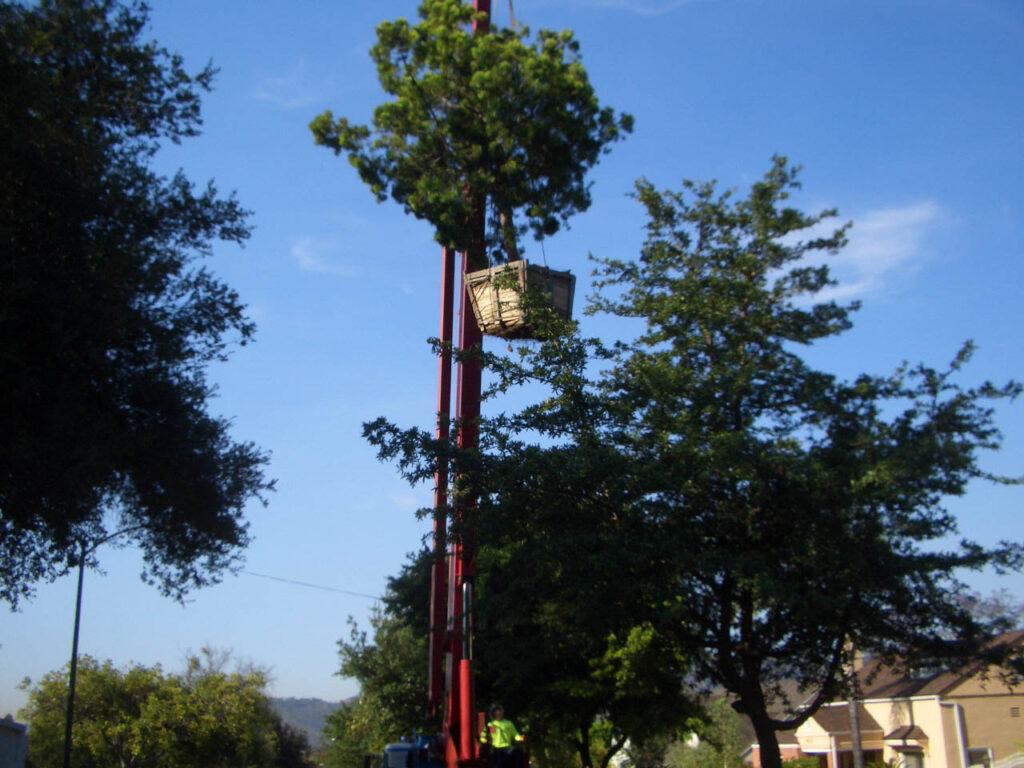
Fallen trees can cause property damage, injuries and death. Safely removing them once they have fallen in an urban environment has to be done so as to not cause more damage. This means highly experienced arborists need to engineer the removable. Flintridge Tree Care is one of the only tree companies capable of removing a fallen urban tree, thanks to our capable teams and custom built trucks and machinery.
Trees and Heavy Rainfall
We have recently been inundated with multiple events of heavy rainfall – a whole lot of water in a short amount of time. While rain is a welcome relief for landscapes in the hot, dry summers of California, there can be a little too much of a good thing, which can cause some issues for young and mature trees alike, such as:
General Tree Stress
Trees respire through their roots, which mean that they take in oxygen and release carbon dioxide through air spaces in the soil. When soil becomes saturated and those pores are filled with water, this function is disabled which can cause stress for the tree. There are a few things we can do about trees affected by standing water after a big rain, but it’s important to try to prevent your tree from becoming more stressed after conditions improve to avoid continued problems.
Consider adding a 3-4” thick layer of mulch out to the drip line of the tree.
Give the tree a long, deep soaking later in the season when it gets hot and it hasn’t rained in a while.
Install water/aeration tubes inside the drip line. These provide deep watering and aeration to the roots to prevent root wrought.
Turn off your lawn irrigation system during weeks when it has rained to let the soil dry out a little. If the soil is wet, the grass doesn’t need to be watered. This can reduce your water bill too!
Do not apply fertilizer when your tree is stressed unless a soil test shows a mineral deficiency, then only amend for that specific problem. Unneeded fertilization stimulates growth that a tree must then use energy to support, further stressing an already weak tree.
Finally, flood stress can be avoided entirely by not placing trees in locations that tend to hold water, or by using flood tolerant species.
Most trees can tolerate short durations of saturated soil conditions when they have a chance to dry out and recover.
Defoliation
A more specific symptom of saturated soil conditions shows up in the leaves. Foliage may start to turn yellow and then fall off, particular in the lower, inner part of the canopy. If soil is allowed to dry out, trees will usually put out a new flush of foliage growth, but prolonged defoliation contributes to tree stress.
Other Foliage Problems
Cool, humid conditions are perfect for fungal diseases to flourish in. We tend to see a lot of leaf spot and powdery mildew in years with a lot of rain. These problems are usually just cosmetic and will not affect the tree long term, but they can cause minor stress. If a tree defoliates, it’s likely to produce new foliage. Just work at keeping the tree healthy otherwise (see the suggestions above), and remove any fallen leaves to dispose of so they do not re-infect healthy foliage. Make sure your irrigation does not splash leaves, which can spread spores and prolong infection. If it’s raining this much, the landscape probably does not need to be watered anyway, right? Repeated defoliation over multiple seasons can cause greater stress and result in reduced growth and additional pest and disease problems. Fungicides may be necessary in these instances, applied early in the season, before symptoms occur.
Root Problems
We have had some issues this spring with trees planted in the last few years having their roots loosened so that the tree has an unnatural amount of sway. This compromises the anchorage of a young tree and can lead to further stress. We recommend placing stakes to support the tree while its roots re-establish in the surrounding soil, to be removed no more than one year later. Larger trees can also experience root issues sometimes after heavy storms/rain events. Signs of root failure include mounding of soil on the side opposite a lean that is becoming more pronounced. If you notice that one of your trees is experiencing this problem, it’s a good idea to contact your Flintridge Tree Care Certified Arborist for a tree risk assessment. Saturated soil conditions are also conducive for root rot organisms. Fungal fruiting bodies at the base of the trunk or near roots could be indicative of root decay. Tree roots scoured out by eroding soil can make a tree more susceptible to root failure.
It’s a good idea to go outside and take a look at trees in your yard after big weather events, just to ensure there are no issues that need attention contact your Flintridge Tree Care Certified Arborist to take the steps to maintain healthy trees throughout the year and this way you can potentially reduce the adverse effects experienced from saturated soil conditions.
Flintridge Tree Care is one of the best oak tree maintenance services in Southern California. When researching and contacting various tree care professionals in the region. Here are some general tips to help you identify reputable services: Flintridge Tree Care fits all of them.
Certification and Licensing:
Ensure that the tree maintenance company is licensed and certified by relevant authorities. In California, the International Society of Arboriculture (ISA) certification is highly regarded.
Experience and Expertise:
Look for companies with a proven track record in oak tree maintenance. Experienced arborists are more likely to provide effective and safe services.
Insurance:
Verify that the company has insurance coverage. This protects you and the workers in case of accidents or property damage during tree maintenance.
References and Reviews:
Ask for references from past clients or check online reviews. Positive feedback from satisfied customers is a good indicator of a reliable service.
Knowledge of Local Regulations:
Oak trees in California are protected by various regulations, so it’s important that the tree care professionals are familiar with and adhere to these rules. Check if they obtain the necessary permits for any work on oak trees.
Services Offered:
Ensure the company offers a range of services, including pruning, trimming, pest control, and disease management specific to oak trees.
Safety Practices:
Inquire about their safety practices. Arborists should follow industry standards and use proper safety equipment to avoid accidents.
Transparent Pricing:
Request a detailed estimate for the proposed services. Transparent pricing with a breakdown of costs can help you understand what you’re paying for.
Environmental Awareness:
Choose a company that demonstrates a commitment to environmentally friendly practices and follows guidelines for preserving oak trees.
Local Knowledge:
Companies familiar with the local climate, soil conditions, and common tree issues in Southern California are better equipped to address specific challenges related to oak tree care.
Communication:
Effective communication is key. Ensure the company is responsive to your inquiries, provides clear information, and discusses the proposed plan of action with you.
Flintridge Tree Care fits the bill for all 11 areas!
Learn how to care for the Native Trees in your yard
Flintridge Tree Care has been caring for trees in La Canada Flintridge for 50 years. There is a lot to know about our trees and their advantages. Contact us at 818-952-5300 and one of our arborists can advise you on the proper care for issues with your trees. Tree Trimming can be one of the most important things you can do to properly care for your native trees. You can contact us through our online form Flintridge Tree Care https://flintridgetreecare.com/?s=forms
One of the best place to visit to learn about Native Trees is Descanso Gardens. You can take tours and learn in person or watch the following videos.
Planting Native Trees is is always a wise thing to do. Native trees when properly planted and cared for increases their beauty and longevity.
Is the best time to prepare for the upcoming El Nino predicted
Trimming your trees in the summer is primarily for shaping and creating a solid structure, in preparation for heavy rains and strong wind conditions. Heavy trimming can be done as long as the tree is not under a tremendous amount of stress. Moreover, it is important to do your summer pruning sooner than later. If you wait too long, you could put the tree at risk of water damage or winter injury. Rain can damage fresh cuts on a tree, so it is better to wait to trim if rain is in the near future.
Remove dead limbs. Summer tree trimming plays an important role in the removal of dead, damaged, and diseased tree limbs. Any limb that has the potential to cause damage or stress to your tree should be removed. This enhances the tree’s potential for robust and best growth while minimizing the chance that a weakened branch will fall on your home during a storm.
Encourage hearty growth. Tree trimming in summer may encourage vigor. In summertime, weak tree growth should be pinched or pruned back about 3 inches from the end of each soft, leafy shoot. This can be repeated again in late summer if rapid side-shoot growth occurs. As always, it is best to leave trimming in the hands of top qualified professionals, such as Flintridge’s arborists.
Help native trees grow strong. Native trees are often good candidates for summer trimming. Tree trimming allows more light penetration, which can support new growth development. Proper tree trimming can encourage mature trees to produce stronger more stable root systems and limb structures. Increased light and air circulation resulting from trimming encourages the overall health of the tree. Tree trimming in the summer helps to support robust and durable branch development, which will help support healthy strong limbs in the future. Some week branches should be removed as they are susceptible to disease during the rainy season. It is best to trim these in the summer, preferably in July, August, or early September. This again promotes the development of sturdy limbs. Opening up the tree and removing the correct amount of foliage sets the tree up for better circulation and prepares the tree for strong winds in the fall, winter and spring time. Summer tree trimming encourages better light penetration to shrubs and planting below. As always, it is best to consult a Flintridge arborist for the care of your trees and property.
Pest Control. Another benefit of summer tree trimming is pest control. By removing weak branches and excess foliage that have mites or aphid damage you are protecting the overall health and longevity of the tree. Often times dead wood in your trees could attract termites. These dead branches should be removed from your tree and property as soon as possible to prevent a termite infestation in your home!
Contact us for an arborist review of your trees to discuss the benefits of summer tree trimming.
VEGETATION MANAGEMENT IS A YEAR-ROUND RESPONSIBILITY
TREE TRIMMING AND BRUSH CLEARANCE REQUIREMENTS
NEW BRUSH CLEARANCE AND TREE TRIMMING REQUIREMENTS FOR LOS ANGELES COUNTY
The state of California has seen an increase in frequency and size of wildfires, including historic brushfires in the city of Los Angeles such as the La Tuna, Creek, and Skirball fires. Additionally, smaller brushfires have been accidentally started by well-intentioned residents performing brush clearance. Therefore, Los Angeles City Council has approved an ordinance to increase requirements for brush clearance and fire safety in the Very High Fire Hazard Severity Zones (VHFHSZ). This ordinance establishes appropriate safety measures necessary to mitigate the occurrence of such fires.
Highlights of the new ordinance include:
Use of metal cutting blades for grass or brush clearance shall be limited to those which are non-ferrous/non-sparking.
Brush clearance cannot be done on red flag days, when fire weather conditions are at their peak.
Individuals engaged in brush clearance operations shall not engage in any other activities during their actual clearance of grass or brush.
An approved fire extinguisher, or a pressurized garden hose with attached nozzle shall be within 10 feet of any grass or brush clearance operation, to quickly extinguish a small fire before it burns out of control.
A cell phone capable of dialing 9-1-1 shall be charged and readily accessible to the grass or brush clearance operation.
Read the full Ordinance here. It is effective now.
Revised – February 9, 2017
CLEARANCE REQUIREMENTS
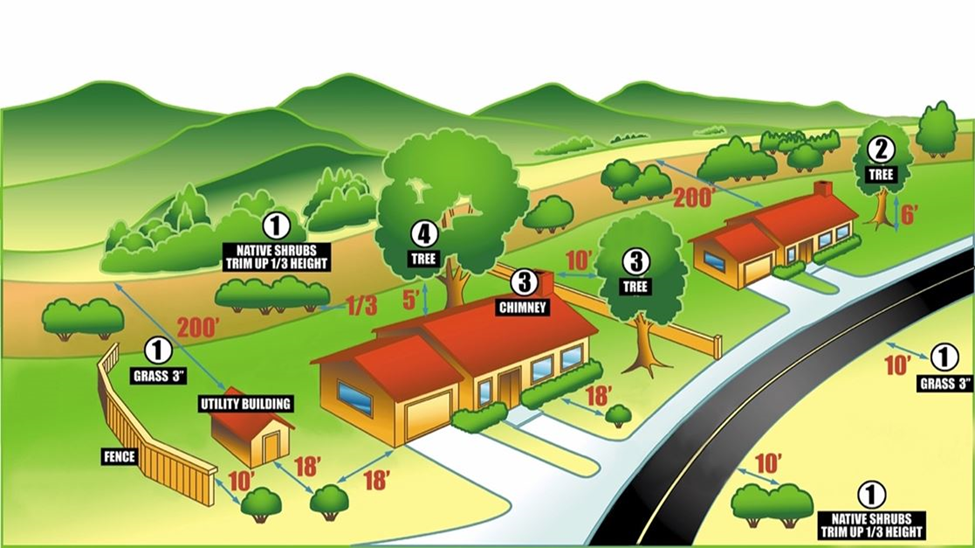
Owners of property located in the Very High Fire Hazard Severity Zone (VHFHSZ) shall maintain their property in accordance with the Fire Code (L.A.M.C. 57.322). Year-round compliance shall be maintained as described below on all native brush, weeds, grass, trees and hazardous vegetation within 200 feet of any structures/buildings, whether those structures are on the owner’s property or adjoining properties, and within 10 feet of any combustible fence or roadway/driveway used for vehicular travel.
1. Areas within 200 feet of structures and/or 10 feet of roadside surfaces or combustible fence: Grass shall be cut to three inches in height. Native brush shall be reduced in quantity to three inches in height. This does not apply to individual native shrubs spaced a minimum of 18 feet apart, provided such shrubs are trimmed up from the ground to 1/3 of their height with all dead material being removed (see diagram above).
2. For trees taller than 18 feet, trim lower branches so no foliage is within six feet of the ground, and remove all dead material. For trees and shrubs less than 18 feet, remove lower branches to 1/3 of their height, and remove all dead material (see diagram above).
3. Trees shall be trimmed up so the foliage is no closer than 10 feet from the outlet of a chimney (see diagram above).
4. All roof surfaces shall be maintained free of substantial accumulation of leaves, needles, twigs and any other combustible matter. Maintain five feet of vertical clearance between roof surfaces and portions of overhanging trees (see diagram above).
5. All cut vegetation and debris shall be removed in a legal manner. Cut vegetation may be machine processed (i.e.,chipped) and spread back onto the property at a depth not to exceed three inches within 30 feet of structures and six inches beyond 30 feet of structures. In addition, spread material shall not be placed within 10 feet of any usable roadside (in accordance with Fire Prevention Bureau Procedure No. 25)
The above general requirements also apply to landscape vegetation.
To Review ALL Enforceable Brush Clearance requirements, visit VMS3.lafd.org “Clearance Requirement.”
VEGETATION MANAGEMENT IS A YEAR-ROUND RESPONSIBILITY
Please call us if you have Trimming and Clearing.818) 952-5300
The Code for Los Angele County
EC. 57.322.1. GENERAL BRUSH CLEARANCE.
No person who has any ownership or possessory interest in, or control of, a parcel of land shall allow to exist thereon any hazardous refuse or hazardous weeds, trees, or other vegetation which, by reason of proximity to a building or structure, constitutes a fire hazard. For purposes of this section hazardous weeds, trees, or other vegetation are defined as weeds, trees, or other vegetation which are in such condition and location as to provide a ready fuel supply to augment the spread or intensity of a fire. Nothing contained in this subsection shall be deemed to preclude the Chief from requiring more than the minimum specific requirements set forth above when the Chief determines that conditions exist which necessitate greater fire protection measures.
SEC. 57.322.1.1. SPECIFIC REQUIREMENTS.
Each person who has any ownership or possessory interest in, or control of, a parcel of land shall comply with the requirements set forth in Sections 57.322.1.1.1 through 57.322.1.1.10.
SEC. 57.322.1.1.1. VEGETATION WITHIN 100 FEET OF BUILDINGS.
Remove from the property all dead trees, and maintain all weeds and other vegetation at a height of no more than three inches, except as otherwise provided therein, if such weeds or other vegetation are within 100 feet of a building or structure located on such property or on adjacent property. This requirement does not apply to the maintenance of trees, ornamental shrubbery or plants which are used as ground cover provided such do not provide a ready fuel supply to augment the spread or intensity of a fire; nor does it apply to a native shrub, provided such shrub is trimmed up from the ground to 1/3 of its height; does not exceed 216 cubic feet in volume; is spaced at a distance of not less than three times its maximum diameter, but not less than 18 feet from the edge of any other native shrub, building or structure; and all dead wood and other combustible material within 18 feet of such shrub is removed except as provided above.
SEC. 57.322.1.1.2. TREES WITHIN 100 FEET OF BUILDINGS.
Maintain trees which are 18 feet or more in height and are within 100 feet of any building or structure or within 10 feet of that portion of any highway, street, alley or driveway which is improved or used for vehicle travel or other vehicular purposes, so that no leafy foliage, twigs, or branches are within 6 feet of the ground. Trees and shrubs less than 18 feet shall be trimmed up 1/3 their height.
SEC. 57.322.1.1.3. CHIMNEY CLEARANCE.
Remove any portion of a tree which extends within 10 feet of the outlet of a chimney or stovepipe.
SEC. 57.322.1.1.4. OVERHANGING BRANCHES.
Keep all trees, shrubs, and other growing vegetation or portions thereof adjacent to or overhanging any building or structure free of dead limbs, branches and other combustible matter. Maintain 5 feet of vertical clearance between roof surfaces and portions of trees overhanging any building or structure.
SEC. 57.322.1.1.5. ROOF MAINTENANCE.
Maintain the roofs of all buildings or structures free of leaves, needles, twigs and other combustible matter.
SEC. 57.322.1.1.6. ROAD AND FENCE CLEARANCE.
Maintain all weeds and other vegetation located within 10 feet of any combustible fence or an edge of that portion of any highway, street, alley or driveway improved or used for vehicular travel or for other vehicular purposes at a height of not more than 3 inches. This shall not require the removal of trees, ornamental shrubbery or plants which are used as ground cover, provided such do not provide a ready fuel supply to augment the spread or intensity of a fire, nor require the removal of native shrubs which meet the requirements set forth in Section 57.322.1.1.1.
SEC. 57.322.1.1.7. SECOND 100-FOOT MODIFICATION.
Clear all hazardous vegetation and other combustible growth within the first 100 feet surrounding structures as required by this section. Reduce the amount and/or modify the arrangement of hazardous vegetation within the area comprising the second 100 feet for a total distance of 200 feet from any structure unless otherwise specified by the Chief. The work required shall be set forth in the Notice of Noncompliance.
SEC. 57.322.1.1.8. LANDSCAPE VEGETATION.
Maintain all landscape vegetation, including, but not limited to, conifers (e.g., cedar, cypress, fir, juniper, and pine), eucalyptus, acacia, palm and pampas grass in such a condition as not to provide an available fuel supply to augment the spread or intensity of a fire. The Notice of Noncompliance citing violations of this subsection will specify that such landscape vegetation poses a threat to buildings or structures in the vicinity and may cause them to be indefensible, and shall describe the work required to be done.
SEC. 57.322.1.1.9. GREATER FIRE PROTECTION MEASURES.
Nothing contained in this subsection shall be deemed to preclude the Chief from requiring more than the minimum specific requirements set forth above when the Chief determines that conditions exist which necessitate greater fire protection measures.
SEC. 57.322.1.1.10. ADDITIONAL BRUSH CLEARANCE REQUIREMENTS.
All individuals performing grass or brush clearance activities in the VHFHSZ shall adhere to the following specific requirements:
1. Grass or brush clearance operations shall not be conducted on red flag days.
2. Individuals engaged in grass or brush clearance operations shall not engage in any other activities during their actual clearance of grass or brush.
3. Individuals engaged in grass or brush clearance operations shall use an appropriate extinguishing agent immediately to extinguish a fire.
4. All fires, regardless of size, shall be reported immediately via the 9-1-1 system to the Fire Department.
5. A Class 2-A two (2) gallon water fire extinguisher, pressurized garden hose with attached nozzle (fully open), or comparable pressurized Class 2-A extinguishing device, shall be within 10 feet of any grass or brush clearance operation.
6. Where a gasoline container is present at the site of the grass or brush clearance operation, a minimum 4A 60 B:C dry chemical fire extinguisher shall be within 10 feet of the brush clearance operation.
7. A cell phone capable of dialing 9-1-1 shall be charged and readily accessible to the grass or brush clearance operation.
8. A safety strap shall be used at all times for any tool or appliance with hot exhaust. Hot exhaust shall not come in contact with any brush, grass, flash fuels, or other flammable material.
SEC. 57.322.1.1.10.1. PENALTY.
A first violation of this section shall be an infraction punishable by a fine not to exceed $250. A second and all subsequent violations of this section shall be subject to the provisions of Section 11.00 of the Los Angeles Municipal Code, including prosecution as an infraction or prosecution as a misdemeanor punishable by a fine not to exceed $1,000, by imprisonment in the County jail for a period not to exceed six months, or by both such fine and imprisonment. In addition to the aforementioned penalties, any violator convicted under this section, which resulted in a fire, may be liable for any civil cost recovery associated with the fire, as permitted by law.
SEC. 57.322.2. INSPECTION AND FEES.
A fee shall be charged for the inspection of properties in the City of Los Angeles to determine whether a violation of this section exists. The fee shall be determined and established in the same manner as provided for in Section 57.106.7. Provided, however, that prior to any inspection occurring, the owner of record of each property proposed to be inspected shall receive a notice advising the owner of the intended inspection, the cost thereof, that penalties will be imposed for nonpayment within the time period specified, and that the owner will not be billed if the owner elects to follow the procedure, or any of the procedures, described in the notice within the period of time specified in the notice. Any procedure which the property owner may elect to follow must be determined by the Fire Department to be one which will provide adequate assurance to the Department that the property does not contain hazardous vegetation as defined in Section 57.322, a copy of which definition shall also be set forth in the notice, and which would not be unduly burdensome upon the property owner to accomplish. In the event an inspection occurs and the property owner is billed the cost of inspection, a penalty shall be imposed if the fee is not paid within the period of time specified in the billing document. Such penalty shall be 200% of the fee imposed, or the cost of rebilling, whichever is greater.
Many urban trees now only live about 20% of their life
Many urban trees now only live about 20% of their life expectancy due to issues like drought, pests and disease, but mostly because of improper care and installation.
A tree should live more than 50 years, and up to 100 years depending on their species. A recent USDA study analyzing tree life expectancy in urban areas finds the typical street tree living between 19-28 years; however, the ideal life span of a California oak is 600 years, and the average life span of Douglas fir and most Pine trees can be between 75 to 150 years in Southern California.
Urban tree planting has increased
Urban tree planting has increased in response to residents’ lack of interaction with nature and the benefits these trees provide the environment through services like cooling buildings with their shade and cleaning the air and water through filtration.
However, urban trees must withstand the drought, pollution, poor soils, limited leg room for roots, and pressure from insects and disease, and their health and cultural requirements are not considered or monitored.
Maybe it’s these urban challenges that cause them to die young; what’s worse, most are planted incorrectly, giving them a poor outlook from the beginning.
Basic knowledge of tree planting can help your urban tree live longer.
However, some basic knowledge of tree planting can help your urban tree live longer. We have 50 years of experience an trained Arborists to advise you.
1) Right tree, right placement.
It is essential that certain growing parameters be considered when choosing what type of species tree to plant. Answer the following questions to choose the right tree.
What are the attractive characteristics? Is the tree deciduous or evergreen? What are the cultural requirements of the tree (sunshine, soil, water and climate)? What is the soil pH and the soil type (well drained or compact)? Does the site get full sun or partial sun? How much water does that tree need? What is the growth rate of the tree? What kinds of things does the tree tolerate (salt, drought, flooding)? What are the insect and disease issues that tree is susceptible to? What are the planting needs and pruning needs of the tree? Can the tree thrive in areas that restrict root growth?
2) Space your trees properly for their mature size.
Small trees that grow 10 to 30 feet tall need a twenty-foot diameter. Medium sized trees that grow 30 to 50 feet tall need a thirty-foot diameter. Large tees that grow taller than fifty feet need a forty-foot diameter. Many homeowners make this mistake by planting a small sapling close to their house only to cut it down later, or over-prune, interfering with the natural shape of the tree.
3) Plant trees at the right depth.
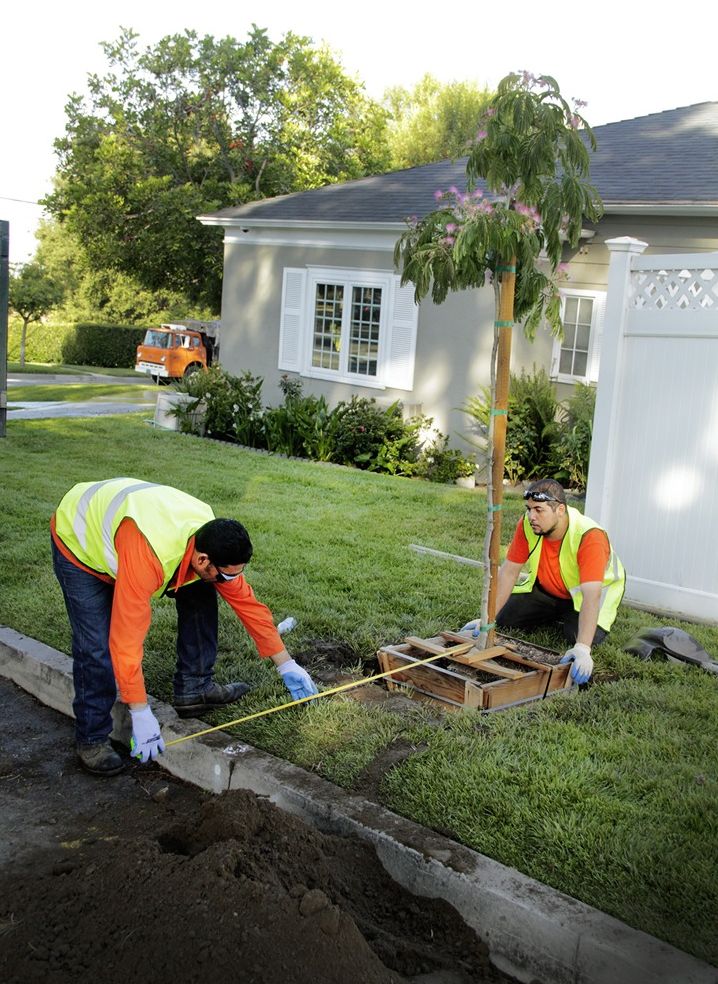
Trees planted too deep look like telephone poles because their natural root flare cannot be seen above the soil line. This strangles the roots below the soil. A proper planting hole is two to three times wider than the root ball and no deeper. (Rough up the sides of the hole with your shovel so roots will spread easier.) Place the tree so the root flare is at or just above the soil line. Sometimes, the tree is planted too deep in the container or root ball it comes in. It is essential that you dig a little to find the top root, and plant at that depth. Avoid amending soil, as roots won’t expand into the less favorable soil.
4) The best thing for a tree in an urban environment is pruning.
The worst thing you can do is improper pruning. Topped trees and stubbed branches weaken new growth and create an avenue for insect and disease. Proper pruning allows strong structural growth, protection from wind, and reduces the risk of tree failure.
The reason urban trees need to be pruned vs. forest trees is that they grow massive side branches, which are usually shaded out in a forest environment. Start corrective pruning the second season of your tree’s life.
5) Use mulch from local trees
Use mulch processed from local trees and avoid rock and artificial mulches. Mulch two to four inches deep as wide as you are willing to go. Properly mulched trees will require less irrigation, less competition with grass roots, and keep trees safe from lawn mower damage.
6) Strangling roots
Strangling roots (commonly called girdling roots) circle the base of the tree rather than spreading out, providing a weak anchor and and cutting off the sap flow to the stems and leaves. These trees will decline and die within five to twenty years. Girdling roots are caused by improper planting, obstructions like sidewalks and curbs, and poor soils.
Signs of girdling roots include: absence of a trunk flare at ground level, leaning trunks, bark cracks, branch dieback, and leaf issues. Data collected at University of Minnesota concluded that a third to half of the trees that fall after a storm can be attributed to girdling roots. It is much easier to prevent girdling roots rather than fix them when tree starts showing signs of decline. At planting, cut off circling roots, follow good planting practices and monitor tree to avoid girdling roots in the future. Some tree species are naturally prone to girdling roots like ash, pine, and oak.
7) Tree Staking
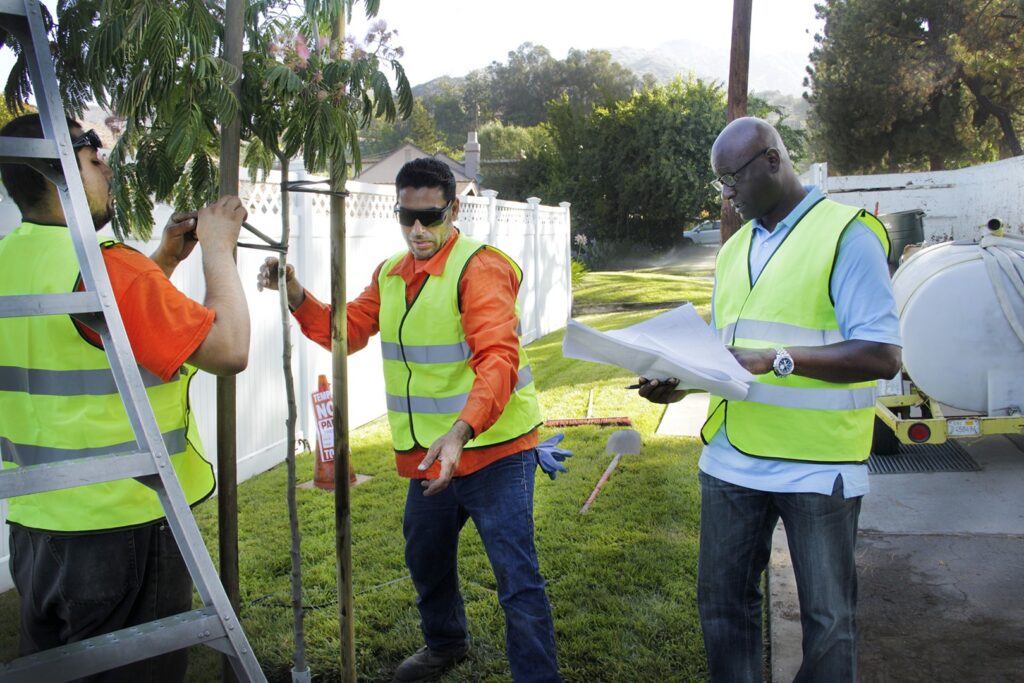
Do not stake your tree unless you have to, and remove them after one season. Only use staking materials if wind is an issue at the site, or to protect from vandalism. Staked trees do not grow strong, develop poor root systems, and suffer from rubbing against their support system.
Learning basic tree care from Flintridge Tree Care you will be increasing the life of your trees and ensuring that they will outlive you, a gift to the next generation.
The drought has compromised the life expectancy of all trees.
Urban and forest trees are dying at a record rate in Southern California
The problem is related to drought or heat. When trees are under drought stress or any other stress, this reduces their defense mechanism in resisting insect damage or disease-causing organisms. Since most trees are so large, it may take several years for the tree to die due to insect, disease, or drought injury.
Start by having one of our highly trained arborists come out and assess your trees
Our trees are part of the value of our property and neighborhoods
We are able to recognize the early signs of weakness in your trees
Recognizing signs of drought stress is important because it can become irreversible, knowing how to mitigate the stress is invaluable
Most all of our competitors do not have the education and experience that our team has developed over the past 50 years.
A Drought Plan needs to be developed
Loss of water around an established feeder root system can kill off a tree fast and watering needs to be done properly. A plan to supply water to these areas needs to be established
Less rain and less watering will kill your trees, we need to supplement this process right away before the damage is irreversible
Grass and shrubs on the surface have died off and less watering is going to the trees and we still need to get water to the trees
Zero scape landscaping and synthetic turf can be killing your trees, this can be reversed with a professionally developed plan
Every tree needs to be assessed and may have deeds that are species specific
Trimming
necessary and unnecessary pruning needs to be assessed by a trained professional
thinning out a tree too much can shock your trees. During our drought trees are already stressed and may not endure the added stress of over trimming.
Deadwood
Trees spend extra energy on deadwood and on trunk suckers and they should be removed
Low hanging limbs need to be removed to so we can move around under urban trees
Insects are attracted to dead wood
Termites only devourer dead wood and they can swarm from your trees to your home in a day, even right after you have tented your home
Bacteria and or fungus
Drought compacted soil cuts off oxygen to the soil and roots and bacteria can grow
Too much water can cause root fungus
A supplemental watering system needs to be well thought out
Watering
Watering in an urban environment can be a challenge
The root zones of our trees are usually shared with our neighbors
Roots establish themselves where there is a water source and when that source is interrupted the tree becomes stressed
Around hard scape
Drip irrigation
This is the most common way to maintain a consistent water source to our trees
Drip irrigation can be unsightly and not practical around hardscape
Drip irrigation can be a tripping hazard
Watering tubes!
Direct root watering
Conserves water by watering directly to root system, eliminates runoff
Collects natural rain/surface water directing it to the root system
Can be connected to low volume automated irrigation supply.
Eliminates tree stress caused by soil compaction.
Root Aeration supplies oxygen rich air directly to the root zone.
Permanent solution for drought conditions.
Establishes tree root zones quicker.
Promotes deep root growth.
Can be used on new plantings or existing trees.
Fertilize directly to root zone with less fertilizer and no run-off.
Installed in a day by one of our team.
Mulch
Holds the moisture so water is utilized and doesn’t evaporate
Decomposition adds much needed organic nutrients to the soil
We produce organic mulch everyday all day
Can be added over drip irrigation and watering tubes
Weeding
Weeds compete for water needed for our landscaping
Weeds use up valuable nutrients from the soil
Fertilizing
Fertilizing a weak tree can add additional stress if done in the wrong manor.
We use time released tablets to avoid shocking your trees
Ideally, we add fertilizer into the watering tubes to ensure direct delivery
Removal
When all else has failed we can remover dead or dying trees and turn them into mulch that will be used around another tree to save it.
Unnecessary planting and shrubs that take too much water
Dead or dying trees all fall, remove them before it’s too late!
During this historic drought, there are several things that you can do to help preserve our urban forest. As we continue to prioritize our water use, it is important to remember that trees are one of our greatest community assets. They improve air quality, provide shade, and beautify our communities. During this drought, they need a little extra care. One of our trained arborists are available to assess your needs.
Tree Trimming Time for Oaks is between July thru October for best results
Most native oak trees are dormant in the summer.
Evergreen oaks are dormant JULY thru OCTOBER. Tree Trimming time for Deciduous oaks that lose their leaves is in the winter.
For deciduous oaks like Engelmann oak, valley oak, and blue oaks winter is the best time for tree trimming.
Coast live oaks are evergreen and therefore dormant thru July and October.
COAST LIVE OAKS ARE COMMON IN THE FOOTHILLS, OF SAN GABRIEL VALLEY AND LOCAL COMMUNITIES, SUCH AS LA CANADA – FLINTRIDGE, LA CRESCENTA, GLENDALE, ALTADENA, PASADENA, SOUTH PASADENA, SAN MARINO, SIERRA MADRE, AND ARCADIA.
OAKS BENEFIT FROM CARE NOW, ACCORDING TO THE COUNTY OF LOS ANGELES.
Now is tree trimming time for your oak trees and many city
municipalities agree July thru October is the best time
 to trim coast live oak trees.
Consequently cities such as South Pasadena and
La Canada-Flintridge strictly mandate these
tree trimming times. A fine can be administered if
pruned outside of times allocated by the city.

California law protects native trees, including oak trees.
The state of California bans the tree removal of native
oak trees and pruning more than
10% without a permit and complete evaluation.
Flintridge Tree Care's
arborists can help you with the evaluation and permit process.
Pruning your oak tree up to 10% is necessary for healthy
 growth and preventative damage.

Oak trees are historical. They existed in the state
during ancient times, according to the city of Los Angeles,
and were used by Native Americans and Spaniards living
in the area.

Healthy prune, when trees are dormant, benefits
your oaks, and sets them up to create new growth
in the spring.  When  oaks are kept maintained the
 chances of getting sick and  dying are reduced. In
addition, they have a better chance  of withstanding
heavy winds.
According to the farmer’s almanac, Santa Ana
 winds typically happen from October to March.
The windier part of the year lasts for 7.1 months,
from October 4 to May 7, with high wind speeds.
 The windiest month of the year in California
in February.  The calmer time of year lasts from
May  to October.  Stay ahead and schedule your tree trimming now.
Get peace of mind from Flintridge Tree Care
and get your free estimate today. Have your
oak trees and other tree pruning done now and
pruned regularly. Regular maintenance of your trees
will save you money, time, and energy.

Set up a regular maintenance plan for your tree trimming and you will not have
to worry any longer. We will take care of your trees and
landscape regularly. Ask about our plans.
Tree Trimming Time for Oaks is between July thru October for best results
Most native oak trees are dormant in the summer.
Evergreen oaks are dormant JULY thru OCTOBER. Tree Trimming time for Deciduous oaks that lose their leaves is in the winter.
For deciduous oaks like Engelmann oak, valley oak, and blue oaks winter is the best time for tree trimming.
Coast live oaks are evergreen and therefore dormant thru July and October.
Coast live oaks are common in the Foothills, of San Gabriel Valley and local communities, such as La Canada – Flintridge, La Crescenta, Glendale, Altadena, Pasadena, South Pasadena, San Marino, Sierra Madre, and Arcadia.
Oaks benefit from care NOW, according to the County of Los Angeles.
Now is tree trimming time for your oak trees and many city
municipalities agree July thru October is the best time
 to trim coast live oak trees.
Consequently cities such as South Pasadena and
La Canada-Flintridge strictly mandate these
tree trimming times. A fine can be administered if
pruned outside of times allocated by the city.

California law protects native trees, including oak trees.
The state of California bans the tree removal of native
oak trees and pruning more than
10% without a permit and complete evaluation.
Flintridge Tree Care's
arborists can help you with the evaluation and permit process.
Pruning your oak tree up to 10% is necessary for healthy
 growth and preventative damage.

Oak trees are historical. They existed in the state
during ancient times, according to the city of Los Angeles,
and were used by Native Americans and Spaniards living
in the area.

Healthy prune, when trees are dormant, benefits
your oaks, and sets them up to create new growth
in the spring.  When  oaks are kept maintained the
 chances of getting sick and  dying are reduced. In
addition, they have a better chance  of withstanding
heavy winds.
According to the farmer’s almanac, Santa Ana
 winds typically happen from October to March.
The windier part of the year lasts for 7.1 months,
from October 4 to May 7, with high wind speeds.
 The windiest month of the year in California
in February.  The calmer time of year lasts from
May  to October.  Stay ahead and schedule your tree trimming now.
Get peace of mind from Flintridge Tree Care
and get your free estimate today. Have your
oak trees and other tree pruning done now and
pruned regularly. Regular maintenance of your trees
will save you money, time, and energy.

Set up a regular maintenance plan for your tree trimming and you will not have
to worry any longer. We will take care of your trees and
landscape regularly. Ask about our plans.